
A photographic journey · 2015–2016
The Long
Way Through
Six countries, twenty weeks, 1,002 photographs. Southeast Asia, November 2015 to April 2016.
I flew into Chiang Mai in November 2015 with a camera, a tripod, and a plan that ran fourteen weeks. The last entry in this journal is dated 9 April.
What I had instead of an itinerary was a habit: go where the people I liked were going, and photograph whatever the day put in front of me. That turned out to work better than the plan I didn't have.
Two things kept happening on that trip, over and over, and looking back they're the reason it's worth writing down at all.
The first is that a small, movement-obsessed crowd — acro yogis, slackliners, fire spinners — kept reassembling around me country after country. I'd meet someone in a park in Chiang Mai in November, run into them on an island in Cambodia in January, and find them again at a festival in Sulawesi in March. Nobody planned it. It just kept happening, and it changed what the trip was about.
The second is that the places built for visitors almost never felt as real as the places that weren't. I learned that the hard way, usually about four hours after paying to get in.
Almost every photograph here is mine. Where I'm in the frame I've credited whoever was holding the camera — unless I simply handed it to a stranger, which happened more than I can count.

CHIANG MAI · DOI INTHANON · CHIANG RAI · PAI · CHIANG KHONG
INorthern Thailand
20 Nov – 15 Dec 2015
Day one. Northern Thailand, 20 November 2015.
For the first day I mostly just walked around town with my travel companion, Chris Avanzato, trying to let it land that I was actually here. We found a small temple called Wat Chaimongkol down the road from our hotel. In the evening we went to the Saturday market on Wua Lai Road — live music, street food, and vendors selling more or less everything. We both walked out with a few pairs of pants that turned out to be the most comfortable clothes either of us owned for the next five months.
Doi Inthanon
On the Sunday we took a tour out to Doi Inthanon, the highest peak in Thailand and one of the gateways to the Himalayan range. Two waterfalls on the way up, a village, and the royal chedis built for the King and Queen.

At the village we watched the women weaving — three days per scarf — and met a man splitting wood. Chris and I asked if we could help and he handed us the axe and let us split a few pieces. It's a small thing. It's also the first time on the trip that someone let us in rather than sold us something, and I've thought about the difference ever since.

The second waterfall, Wachirathan, was enormous. From there we carried on up to the summit and walked the Ang Ka nature trail through the national park, where the air was clean in a way that's genuinely hard to describe.

Naturally we had to do a little acro yoga at the highest point in Thailand. We played around in the cold mountain air with that view behind us, and by the time we finished a small crowd of travelers had gathered to photograph us. It was the first time on the trip that a handstand turned into a conversation with strangers. It would not be the last — it became, more or less, how I met everyone.
Lanterns
We'd planned to celebrate Yi Peng at Lanna Dhutanka, but the mass lantern release was cancelled that year because of the risk to planes flying in and out of Chiang Mai. A smaller ticketed release was still on at $100–150 a head, and it had sold out by the time we tried.

So we went down to the river for Loi Krathong instead, the festival honoring water, and released our own. The streets were packed — it felt like Thailand's answer to the Fourth of July. Lanterns and fireworks going up everywhere, and the fireworks were the real thing, sold openly to anyone who wanted them. We bought a few and set them off ourselves. I still have all my fingers.

A couple of nights later we found a place called Tea Tree Café, and walking in felt like coming home — a room full of travelers, an easy jam session, everyone playing music together. I drank a very good kombucha and did acro on the floor with a traveler from Oregon named Kena, whom we'd met in the park that afternoon. It was the night it became obvious this trip was going to be about the people more than the places.
We went back on the Friday for open mic — "open heart night," as Howie, who runs the place, called it. I have never liked public speaking. But something about that room made it feel survivable, so I read out a letter I'd written to my future self years earlier during a smoking cessation course, a piece of writing I had never planned to read aloud to anyone. My voice shook partway through. Afterward I shared what I was grateful for that year, since it was Thanksgiving back home. People told me I did well. What mattered more was having been part of the energy in that room at all.

Apple, and then the White Temple
Chris and I were at Buak Hat Park almost daily, practicing acro and taking turns on our friend Sara's forty-meter slackline. I made it all the way across by the end of the first day of training. A few days later I fell from high up, landed hard on my elbows and banged up my right shoulder. Massages in Chiang Mai are wonderfully inexpensive.
Through the park we met Apple, who runs the Hug Academy — a place where kids learn music, art, boxing and dance. Sara had been teaching the children to slackline and we joined in. Apple took us to lunch at her favorite local restaurant, then to her workshop, where she makes silver jewelry. I bought a silver feather for my hair. We ran so far over on time that we thought we'd missed our window for Wat Phra That Doi Suthep, so Apple drove us up there herself, with her son Harley and her husband. The monks were praying and chanting when we arrived. It was the kind of afternoon that only happens because a near-stranger decides to treat you like family.
The next morning we left at 6:30 for Chiang Rai to see the White Temple, and it was the exact opposite experience. Three hours on a bus, then staff shouting through megaphones to keep moving and not block the paths, whistles blowing at us the entire time. Inside — where photography isn't allowed — the artwork is genuinely beautiful, right up until I noticed Neo from The Matrix painted into one of the wall panels, next to Transformers being held aloft by some kind of squid. Out on the grounds there were severed heads hanging in the trees: Iron Man, Batman. On the outskirts, a diorama of Alien vs. Predator.
One day we were family at a quiet temple on a hillside. The next we were livestock being herded past a gift shop. That contrast is the reason this stop stuck with me at all, and it set the pattern for the whole trip.
From Chiang Rai we set out for Mae Salong hoping to ride ponies through the mountain tea fields, made it halfway before the roads got too dark and dangerous, and learned along the way that Chris, at over 80kg, was too heavy for the ponies anyway. We hitched back to Chiang Rai with a very kind man in a truck, tried our luck again toward Chiang Mai once we realized the buses had stopped, got nowhere, and had a great time failing. We ended up at the night bazaar and a guesthouse called Jasmine.
Pai
By the Thursday we were on a bus to Pai, checking into Circus Hostel — and we walked in on people spinning poi, juggling, doing acro, slacklining, swimming, stretching. The place was gearing up to host a circus festival that weekend. It felt instantly like we had landed exactly where we were supposed to.
I taught my first acro yoga class there, alongside a traveler named Kristina Pipova. The next day I taught a workshop with over thirty people in it, most of them trying acro for the first time. That evening the instructors performed, and I did a piece with Kena where I based her while she spun one hoop on her foot and two more in her hands. Chris lit his rope dart on fire and put on a genuinely great show.
We spent the following week riding scooters to Pam Bok Waterfall, the Land Split, the White Buddha at sunset. Someone handed us free Roselle juice on the road home. We rode sixty kilometers over the hills to Cave Lodge, walked out to the mouth of the cave at dusk and watched a few thousand swifts pour in overhead, then explored three caves the next morning, one of them with a waterfall inside. Our group had started calling itself The Herd.
On 14 December we said goodbye to Pai over a last breakfast at Lemon Thyme and caught a minibus to Chiang Khong, seven hours, arriving at 1:30am. We crossed into Laos at 8:30 the next morning and by 11:30 we were on a slow boat with about a hundred and fifty other people, headed seven hours downriver to Pakbeng. Green hills the whole way, fishermen working off the jagged rocks along the bank. A group of guys my age got loudly drunk near the bar, so I put my headphones on and watched the river.
Contact sheet 24 more frames from Northern Thailand

PAKBENG · LUANG PRABANG · POU LUANG · KUANG SI
IILaos
16 – 22 Dec 2015
Climbing into the cloud layer above Ban Som.

Pakbeng knows it is the only real option for slow-boat travelers, and its prices reflect that. We were on the boat again by 8:30 for another eight hours down to Luang Prabang, and met friends from Thailand — Oliver and Adam — at the night market when we landed.
The plan for the next day was to visit a tribe in the hills, but the rain made the road too treacherous, so we spent it walking the city and its temples instead.

Three hours up
Friday we were up at seven and riding with a guide named Hung Pen — his nickname translates to "expensive" — across the Mekong by canoe for about 5,000 kip, roughly a dollar, then twenty kilometers by tuk tuk to Ban Som village. From there we walked.


Puppies and children in the street, water buffalo along the trail, and then three hours of climbing to Pou Luang at about 1,300 meters. We had not seen another traveler since crossing the river.

We stayed in a homestay where we could cook and sleep. It was cold up there, and foggy most of the time because we were inside the clouds rather than under them. There's a school in the village with a barbed-wire fence around it, which is to keep the animals out rather than the children in.

We came back down the next morning. Our guide had been getting on all of our nerves by then — a lovely man and an absolutely relentless talker, including at the exact moment everyone was trying to fall asleep — and at the bottom of the hill we had to negotiate a ride back to the river.
Anna Vu's table
Back in Luang Prabang we took it easy at the guesthouse we'd been storing our bags in, the Sieng Khaen Lao. Oliver is a seriously talented artist, and he offered to paint the reception wall in exchange for two free nights for the five of us. They took the deal.

We rented motorbikes and rode out to the Tad Sae waterfalls, arriving late in the day so it felt like a private visit, then to Kuang Si early the next morning ahead of the tour groups.

That evening Anna Vu, the woman running our guesthouse, invited us to a family dinner. She was thrilled with Oliver's mural. It was a wonderful Vietnamese meal, a lot of dishes and a lot of rice alcohol, which is strong. Afterward we all went to Youtopia and talked for hours.
On the 22nd we packed up and left for a twenty-six-hour sleeper bus east to Hanoi.
Contact sheet 56 more frames from Laos
HANOI · HALONG · NINH BINH · SAPA · PHONG NHA · HUE · HOI AN · NHA TRANG · DA LAT · MUI NE · SAIGON
IIIVietnam
22 Dec 2015 – 15 Jan 2016
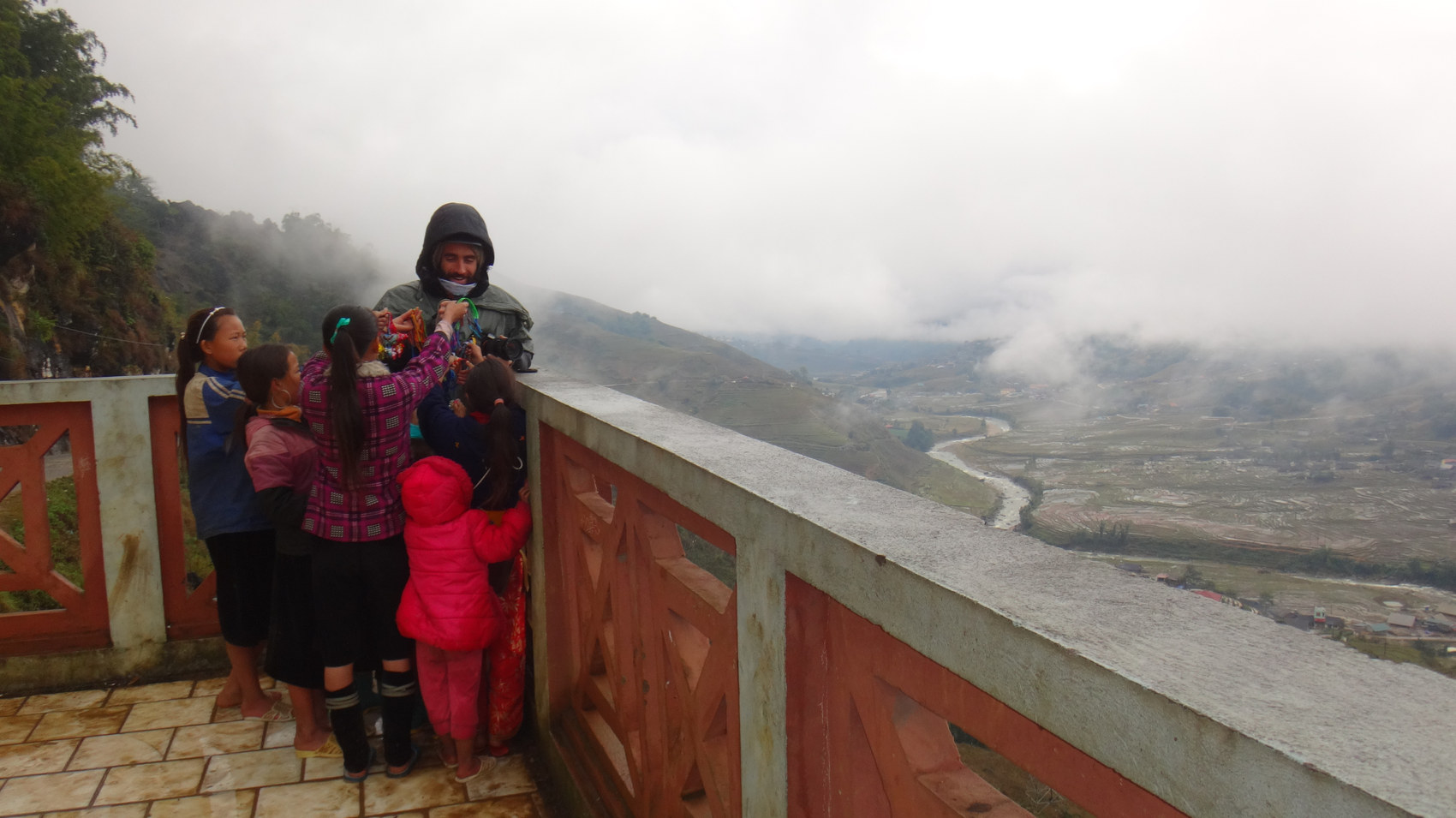
Sapa, inside the cloud. Visibility about fifty yards for three days.
The twenty-six hours started badly. My stomach turned about ten minutes after we pulled out of Luang Prabang, there was no bathroom on the bus, all my medicine was stowed underneath, and I spent the first eight hours asking a driver who by then actively disliked me to pull over. Eventually he handed me fifteen or twenty small brown pills and told me they'd be good for my stomach. I ate them immediately. Two hours later I felt fine. Only seventeen hours to go.

Christmas in Hanoi came with a free meal and drinks at the guesthouse, and Jorden gave all of us matching shirts that said The Adventure Team, which is what we'd been calling ourselves anyway. She made it official. We put them straight on.

Halong Bay

We left for Halong at eight and were on the water by noon, stopping on the way at an extraordinary studio staffed by disabled artists that none of us expected and all of us remembered. On the boat: lunch, caves on one of the islands, dinner, and a swim in the bay in the dark.
The next morning Oliver and I took a kayak out at 6:30. We thought the guide had said an hour and a half. He had told everyone else one hour, after we'd already left. We paddled to a nearby island, found a cave, went through it as far as we could, and came back two and a half hours later to a genuinely furious tour guide. Worth it.

From Halong we bussed to Ninh Binh, rented motorbikes and rode out to Mua Cave, climbing to the top for a view over what people call the Halong Bay of the land. Foggy and overcast, but the cascading rock formations came through it.

Sapa
Stefanie and I split off from the group to go north to Sapa. Everyone else wanted to head south into the warmth, and I very nearly skipped it — everyone said it was rainy, foggy, overcast — but I didn't want to regret it. We took a sleeper bus up and arrived at 4am.
It was cold in a way I was not dressed for. On what counted as a warm day I was wearing two pairs of pants, three sweatshirts and a beanie. By New Year's Eve it was a shirt, two pairs of pants, three jackets, a full body raincoat, a beanie and gloves I'd bought the day before, and I was still freezing on the ride up to the waterfall. The clouds got denser the higher we went. When we arrived it was too thick to be worth going in.
Sapa also comes with a warning I'll pass on: you will be approached constantly. It's a few minutes of walking before it starts — where are you from, what's your name, you buy something — and it continues down the street alongside you. If you already bought the thing, you should buy a second one. At the viewpoints there's often a group waiting, close enough that taking a photograph of the view becomes difficult. I like to think I'm a patient person. It wore me down.

Walking down through Cat Cat Village a Vietnamese family asked whether we'd talk with their children in English so they could practice, so we walked and talked together. Near the bottom, by the waterfall, one of the boys climbed out on the rocks over the river, slipped, and went in. He hurt his knee, lost his camera, and came out soaked and sobbing in about forty-degree weather with no quick way back. I ran down and pulled him out, and the locals and his parents got him stripped and into dry clothes. His family were extremely grateful. It's the clearest example I have of the thing about that village: the place was built for tourists, and the best moment in it had nothing to do with that.
New Year's Eve we had a buffet at the Mountain View Hostel to try to meet people, which worked, then went to the Hmong Sisters Bar where it seemed like the entire town had turned up. On the Sunday we took a three-hour bus to the Bac Ha market, which is genuinely for the people who live there — livestock, meat, tools, toys, clothes, food. I bought bags and instruments as gifts.

Afterward we visited a Hmong village that was very clearly tourist-driven, and the authenticity had gone out of it — cheap corn wine at a dollar a liter, a rehearsed route through. Same day, two villages, two completely different feelings. Then up to the Vietnam–China border, the farthest north we could get, and back to Sapa.
Down the coast
From there I bought a hop-on hop-off bus ticket — about $67 for seven stops all the way down to Saigon — and started working my way south. Phong Nha first, arriving at 5am, which turned out to be a great time to arrive. Botanical gardens, the Gio waterfall, mosquitoes in genuinely absurd numbers, and Paradise Cave, which is without question the largest cave I've ever been inside: a walking platform running a kilometer in, with another six kilometers beyond it that cost four times as much and take all day.

In Hue I met the owner of my hotel, Phong, who was one of the warmest people I met in Vietnam, and rented a motorbike to see the Thien Mu pagoda and the Imperial City. I also got taken for a couple of hundred thousand dong by a very friendly man named Ni, who bought me lunch and a face mask, invited me to a family party in Saigon, and then asked me for 750,000 dong toward a bottle of wine. I talked him down and left fast. It was a good reminder that generosity and a setup can look identical for about two hours.

Hoi An, then a twelve-hour night bus to Nha Trang, where I swam in the ocean for the first time in months and rode out to the Ba Ho waterfalls in rain that felt like being shot at. Then up into the mountains to Da Lat, where the Dalat Family Hostel greeted me with more warmth than any hostel I've ever walked into — hugs, kisses, an immediate invitation to lunch. Mama there will feed you until you physically cannot continue.
Da Lat gave me the two best riding days of the trip. Dantala with Ramona, coasting eight kilometers down the mountain after we ran out of gas and stopping, by pure luck, directly in front of a gas station. Then fifty kilometers out to Pongour, which was the waterfall I'd come to Da Lat for — large, long, and beautiful, with rainbows underneath it.

The day after that, Lynn, Gavin and I rode to the Tiger and Elephant waterfalls, hitting 120km/h on the downhill stretches of highway with a headphone splitter between us so we could listen to the same music while she navigated on my GPS. In the evening we went back to the House of 100 Rooftops, which is like the Crazy House but roughly ten times more so — a maze of staircases and holes and little seating areas. I brought the camera the second time. The pictures don't do it justice.

Mui Ne was a single evening. I got in at five, hopped on the back of someone's motorbike and made the red dunes with a little light left. Then Saigon: the post office, the Notre-Dame basilica across from it, the City Hall — designed by the same architect as the Eiffel Tower — and a church where people were chanting prayers inside.

Contact sheet 268 more frames from Vietnam

KOH TA KIEV · KAMPOT · KEP · RABBIT ISLAND · PHNOM PENH · ANGKOR
IVCambodia
15 Jan – 8 Feb 2016
Coral Beach Resort, Koh Ta Kiev. HDR panoramic — the frame that paid for a week.
I crossed the border at 7am and got to Sihanoukville that night, where I walked into Chris, Yarden, Kena, Pocket and Tess all in one room. Four countries and two months since Chiang Mai and here they all were. We did some acro, ate, and slept.

In the morning we got on a boat to Koh Ta Kiev to stay at Coral Beach, and stopped to cliff jump on the way. On my second jump I threw a gainer off the seven-meter rock — the highest I'd attempted one from. All I wanted was to not land on my back. I did not land on my back. What I landed on, with my legs open, was considerably worse. Twenty-five minutes of breathing heavily.

The camera starts earning
Sandro and Mel were running Coral Beach, and while I was on their slackline I mentioned in passing that I did photography, and that if they ever needed images of their piece of paradise for marketing, maybe we could help each other out. He looked at some of my work and said yes.


I got my laptop brought over from the mainland and spent the next few days shooting and editing for them — HDR frames and panoramas of the property, the beach, the bungalows. They were thrilled with the panorama of the whole site. In between I did more acro with Kena than I had managed anywhere on the trip, and we taught a class in the afternoon that turned out well.

There were hammocks with mosquito netting, so well insulated that one night I got too hot and had to walk into the sea at 2am to cool off, under the stars, with the phytoplankton lighting up green around me. Life is hard.

On our last morning we did one more acro session with people staying there and with some of the locals, went snorkeling when the sun got strong, and packed up. Mico at Kactus had, by then, offered the whole group free accommodation, food and drink for a day on the strength of the pictures.
Kampot, and a broken-down bus
The ride to Kampot went wrong immediately. The company didn't collect us, told us to find our own way to their depot, and we arrived to about a dozen equally unhappy travelers. The shuttle finally came with about thirty seconds to spare before refunds started. Then it turned out the engine problem hadn't actually been fixed, and we proceeded toward Kampot at a stately 15km/h, being passed by everything on the road, stopping twice for coolant — the second time using the passengers' drinking water — before pulling into a mechanic's yard for another hour and a half.

Kena and I got out and started doing acro in the yard. Within a few minutes people were being called out of their houses to come and watch us "perform." It went from a broken bus to the best hour of the day, and I have thought since that this is more or less the whole trip in one scene: the plan failed, and the thing that replaced it was better.
Kampot itself gave us Bokor National Park, which cost twenty-five cents a vehicle to enter and cost us three separate motorbike breakdowns in one day. We ditched one bike on the mountain, rode three-up on the other, and made it to the old palace on top, above the clouds. Do not rent from Giant Ibizza in Kampot for anything beyond city use.

Then Arcadia on the river, with a floating dock and a high dive and a full moon coming up behind it; Rabbit Island for two nights in a $10 bungalow, with a rooster that started at 2:30am and kept going; and a temple inside a cave dating to around 700 AD, twenty kilometers out, ten of them off-road, where we needed a fourteen-year-old local boy as a guide because it was pitch dark inside. He spoke excellent English, had a great sense of humor, and charged two dollars for the three of us.

Phnom Penh
I had a day in Phnom Penh between buses. The Russian Market first, where you can find essentially anything. Then the Killing Fields, which was a heavy education about a genocide in the late seventies that I had somehow never learned about. The memorial stupa was built in 1988. Seventeen levels. The first ten hold over nine thousand skulls.

Then Wat Phnom, the Royal Palace gates just after they closed, and at dusk the Eclipse Sky Bar on the twenty-third floor, which was wildly overpriced and had exactly the view I wanted. Forty kilometers and five hours of tuk tuk for twenty dollars.
Angkor
I got to Siem Reap at 6:15 in the morning and gave myself a few days before the temples. Then on 2 February I was up at 4:30 with my camera and a two-dollar push bike, riding fifteen minutes on flat ground to Angkor Wat for sunrise. A three-day pass was $40.
Angkor Wat at sunrise is very touristy, and I decided then that next time I'd go to one of the outer temples instead. Which is exactly what I did three days later — up at 4:30 with Kelly and Miles, out to Jayatataka lake to watch the sun come up over the water with almost nobody there, then waiting at Preah Khan until it opened at 7:30 so we could be the first people through the gate. Walking a temple like that with no one else in it is a completely different experience from the same temple two hours later.


We rode forty or fifty kilometers that day and saw around ten temples. The roads through Angkor are well kept and flat and mostly shaded by jungle, with monkeys, dogs and elephants along the way. Be careful with the monkeys — they're photogenic and they will absolutely go through your bike basket. We made friends with an Icelandic cyclist we nicknamed Viking, because none of us could pronounce his actual name, who got bitten and had to go to hospital for shots he hadn't had before coming out.

I left for Bangkok on the 8th: fourteen hours of travel, four of them in the busiest border queue I'd seen, made busier by Chinese New Year. Somewhere in the loading of the bus that morning, someone unclipped both buckles on my backpack and removed my tripod. That was the second one gone. The first had been broken by rough handling on the buses in Vietnam, which is why I'd bought a replacement in Hoi An. I'd buy the third in Bangkok, because for the way I shoot I need one.
Contact sheet 181 more frames from Cambodia

BANGKOK · KOH PHI PHI · KOH LANTA · KOH MUK · TRANG
VSouthern Thailand
8 – 19 Feb 2016
Koh Phi Phi from Viewpoint 2. HDR panoramic.
Bangkok was malls and rooftops. Miles and I went through four of them hunting a tripod — Central World, MBK, Siam Center, Siam Paragon — and I'd recommend MBK if you want to haggle for electronics and Central World's seventh floor if you want the food court. We wandered into a Rolex workshop where you can watch the watchmakers through the glass in lab coats, and left with a seven-pound catalog they gave us for free.
In the evening we took the sky train and ended up at Cloud 47, a bar forty-seven floors up. Six dollars a beer, which is a lot in Bangkok and completely worth it for that view.

8:00 versus 8:30
The best two hours I had in Bangkok cost 100 baht. I got a taxi to the marine department port and a 13-baht river boat to Wat Pho, and arrived as it opened at eight, one of the first people through. It was beautiful and it was quiet, and I walked around it slowly and photographed it properly. The reclining Buddha there is forty-six meters long, one of the largest I saw anywhere on the trip.

I asked at the entrance whether I could come back on the same ticket, and she said that was fine. So I went to the Grand Palace when it opened at 8:30, and nearly turned around at the gate. Hundreds of people funneling through security. Five times the price, at 500 baht. Inside, an uncomfortable density of selfie sticks, and no photography allowed in the temples. I got a few frames here and there and spent the last stretch of the visit looking forward to leaving. Then I went back to Wat Pho, which by that point had filled up too.

The islands
Koh Phi Phi is expensive — a curry that costs 30 or 40 baht on the mainland is 130 there, and water that costs 14 goes to 25 or 50 — but it earns some of it back at the viewpoints. Thirty baht gets you up to all three.

I met Larissa up there and we walked and talked and watched the sun go down, and she got a photograph of me shooting the frame that opens this chapter, which I like more than I expected to. That evening I ended up at a karaoke bar packed with live music, and the following night on the beach where the parties actually are — fire spinners, jump rope on fire, flaming limbo. I did the limbo. I felt the heat of it on my face.
In between there was a forty-five-minute walk to Long Beach because a guy at the dive shop told me it was the best snorkeling on the island. Someone at the water said they'd just seen reef sharks out by the rock, so I rented a mask for 50 baht and swam the five hundred meters out. No sharks. But an extraordinary number of fish, and an hour and a half of diving down to swim with them while they drifted away from me.

I should say the other thing too. On the roads less traveled on Phi Phi there was a lot of trash, and there was more washed up on Long Beach in Cambodia and in the water at Last Point. There's a 20-baht environmental impact fee when you land. The beaches themselves were clean. Fifty meters inland was a different story.
Koh Lanta for a day, where I split a 150-baht scooter with a photographer from Austria named Andreas Wagner and we rode the length of the island. I swam out about forty meters to a small island called Ko Lek, and Andreas got a frame of me standing on the reef that makes it look like I'm walking on water, which amuses me because people kept calling me Jesus on that trip.


Emerald Cave
Koh Muk was the quiet one. Miles, Cayla, Sam and I stayed at the Muk Gardens Resort on the west side, right on the beach, with free snorkel gear. On the Tuesday we ate three breakfasts each, waited for the tide, and kayaked three hours around the island to the Emerald Cave, stopping to snorkel along the way.
The cave is eighty meters long and parts of it are absolutely black — you want a headlamp. We got there around four, which is when the boat tours leave, so within about ten minutes we had the entire cove to ourselves.


We paddled back to Charlie's Beach against the wind, which made the last stretch hard work, missed the ride home, and ate dinner on the east side watching the sun set instead. A few days later I swam back out to the cave alone with just a snorkel, maybe three kilometers, and went through the pitch-black section without a light. It was a fun, stupid challenge. Take a headlamp.
On the 19th we took a boat into Trang and decided, over the biggest green tea I have ever been handed, to go to Kuala Lumpur that night.
Contact sheet 86 more frames from Southern Thailand

HAT YAI · KUALA LUMPUR · BATU CAVES
VIMalaysia
19 – 26 Feb 2016
A man prays at the foot of the Batu Caves stairs, before sunrise.
We crossed at 6:30pm, cleared customs by about nine, and got into KL at five in the morning, before the trains ran. We used maps.me and Hostelworld to find Raizzy's on foot and overshot it several times because we were talking. They couldn't check us in until two, so we had a two-dollar Indian breakfast around the corner and a very slow morning.

Four hundred steps, before dawn
On the Tuesday we were up before sunrise — out of the guesthouse at 6:15 with Miles and Carmen, on the train at 6:45 — and climbed the four hundred steps into the Batu Caves while it was still dark. Indian prayer music was being played live inside, and people were praying in the half-light. There was almost nobody else there. It felt like a private experience in a place that gets millions of visitors a year.

We did a little acro in the cave. Then the long-tailed macaques came down looking for breakfast, and a few of them put on a show. We gave a prayer and had a morning blessing before we went down. It was a fantastic morning, and it happened for exactly one reason, which is that we got out of bed at 5:45.


Later that week I found the same thing next door to our guesthouse. I heard a parade outside, went down, and it was an Indian parade with live music leaving from the Sri Mahamariamman Temple, so I followed it back inside. The same blend of sculpture and painting, and some of the most beautiful temple artwork I saw anywhere on the trip, thirty seconds from where I was sleeping.

Tripod number four
There was a thunderstorm forecast, and I wanted to shoot lightning over the city from the KL Tower, which meant I needed a tripod — my fourth of the trip, and I had no confidence it wouldn't need replacing again. So I refused to spend money on it, went looking, found nothing but bad tripods at unreasonable prices, and eventually caved and bought a very light, very cheap one.
Carmen and I paid 105 ringgit each to get up to the open deck at seven. The wind up there felt like thirty miles an hour. The lightning was far off in the distance with no distinct bolts. My camera on my brand new terrible tripod would not hold still, and I spent a long time trying to use my own body as a windbreak. I got one decent frame of the city.

At a certain point it stopped being about the shot and we just enjoyed being up there, and did acro on the observation deck for an hour and a half until it closed at ten.

On my last afternoon the people running the guesthouse asked Miles and me to do some acro in the courtyard. We played around and pulled in whoever we could. The woman running the place took what must have been five hundred photographs. Then I flew to Indonesia, missed my connection in Jakarta by thirty minutes thanks to a shuttle, a traffic jam, a car accident and a four-kilometer detour, and spent the night in an airport.
Contact sheet 56 more frames from Malaysia

PALU · TANJUNG KARANG · ECLIPSE FESTIVAL · UBUD · MOUNT BATUR · GILI ISLANDS
VIIIndonesia
26 Feb – 9 Apr 2016
9 March 2016. Totality, for just under three minutes, over Sulawesi.
I landed in Palu and found Kena, and we bought a tent, a mattress, ropes, a lantern and pillows for about $115 split between us, because the next few weeks were going to be camping. Then we went out to Tanjung Karang, an hour away, and the water there was the clearest I have ever been in — thirty meters of visibility, colorful fish everywhere, an eel, a cuttlefish twenty meters down changing color so fast I dove to look at it and it was gone.
Walking into the village from the beach is its own experience. A lot of people there had never seen white people. Everyone says hello with an enormous smile, and if you stop moving for a second a crowd forms and everyone wants to "make a picture" with you. We stopped at a fruit stand and had about fifteen people wanting a photo.

One morning the army turned up in a truck to tell us they were looking for terrorists and expected someone to parachute in. Nobody was in uniform. Then they all wanted photographs, so we did a thirty-minute shoot with them. Kena and I did a little acro, which they loved, and I got two of them to try it — and I have since had second thoughts about that, because the language barrier was total and dropping a soldier on his head would have been a genuinely serious problem. Everyone was fine. They bought us durians and left. An hour later the police came by for the same reason.

I was snorkeling in the shallows one afternoon, pulling myself along the bottom with my hand, hunting for shells to make necklaces from, and came face to face with a stonefish. It is one of the most venomous fish there is. I did not touch it. That was close.
The eclipse
The festival opened on 6 March and the campsite filled with an extraordinary mix of travelers, with locals coming out to see the travelers. We got our tarp up over the camp, mostly — the wind was strong enough that we ended up using white mesh instead, and agreed that if it rained hard we'd use the tarp as a slip and slide down the hill.

On the 8th, two local tribes performed for us — traditional songs, traditional dress. It was one of the most generous cultural experiences of the whole trip. Partway through I turned around to see my friend Troy in tears watching it, and got the frame. Tears of joy. That performance was very powerful.

The next morning I lay on our tarp with mellow music in my headphones and the psytrance kick from the main stage coming up through my body, which is a genuinely strange way to spend a morning. Then Troy held a guided meditation in the dome to give the eclipse some intention. I sat next to him. He filled that room with so much love that it was easy to carry it around for the rest of the day.
As the eclipse came in, the music stopped and everyone gathered and howled.

It was a total eclipse for nearly three minutes and unlike anything I'd seen. Maybe because we were nearly on the equator, or because it was still early morning, but it was enormous. The light was the strange part. Not cloud light, not sunrise or sunset light — everything just went grey, and then dark. People were hugging and crying. We were, by any measure, the lucky ones: in one of the best places on Earth to see it, entirely by accident of where the previous four months had taken me.

The following afternoon Kena and I taught a beginners' workshop with nearly thirty people in it, with Anna playing hang drum to set the pace. We covered bird, folded leaf, back bend, straddle pike, straddle bat and some therapeutics, and ran two hours. Later that night another acro yogi named Marge pulled me into a performance where she did fire on top of me while I based her. Extremely improvised. People loved it.
Ubud
Bali was a month of work and jams. Acro at Radiantly Alive and at The Shift Hotel most days, teaching whenever a hostel got curious, eating at 9 Angels where you serve yourself, pay what you think is fair and wash your own dish.

Two things I turned down there, both for the same reason. We rode out to a coffee plantation to try Luwak coffee and found the luwaks in cages, so we left without buying anything. On the way out we met an uncaged fruit bat with a meter wingspan who seemed perfectly happy, and Selena and I fed him fruit. A few days later at another plantation, same situation, same decision.

Mount Batur
We were up at 2:10am, met the guide at 2:15, left for the mountain at three and started walking at four. I knew it was a popular hike. I did not expect the parking lot to be full at 4am, or to hear that four hundred people a day make that climb. There was actual foot traffic on the trail.
Two hours later, at the top, I understood why.

We came down at ten, got back at eleven-thirty, closed our eyes for half an hour and went straight to the 1pm acro jam. My legs cramped through most of it.
Being hired

In Canggu I photographed a clothing line for Jessica, whom I'd met at the eclipse festival on a day when she was having a hard time and I'd been able to lift her spirits a bit. Her models came for breakfast and we shot all morning, playful and easy. Then at the end of March came Bali Spirit Festival, where I arrived early to photograph the event's sponsors and spent the days walking the site shooting.

After Bali came the Gilis with Emelie and Zac — a beach cinema showing Mad Max with popcorn for 50,000 rupiah, snorkeling with sea turtles, an accidental afternoon in a very fancy resort pool we had absolutely no business being in, chess and a hummus platter with a chef who was so kind we promised to come back the next night, and did. The last stretch of my notes gets thin, which tells you something about how the trip ended: I got sick, I rested, and then it was over.
Contact sheet 256 more frames from Indonesia
What I brought back
I left with a plan to photograph places. I came back having mostly photographed people — Hung Pen on the trail up Pou Luang, the cooks at Coral Beach, a woman meditating in a bungalow who never knew I was there until I asked, a man praying at the foot of four hundred steps in the dark.
Almost none of that was planned either. It happened because I spent five months being the guy who asked, who showed up before the light did, who handed his camera to a stranger and trusted it would come back. Somewhere in there I stopped photographing the view and started photographing what was happening in front of it.
That is still how I work. I get to a venue before anyone else does, because the room at 7am is a different room. I make the pictures nobody asked for — the cook, the driver, the grandmother at the edge of the frame — because those are usually the ones people keep. And when I hand someone a photograph of themselves that they weren't expecting, I know exactly what that's worth, because it happened to me for five months straight and I never got tired of it.
Four tripods. Six countries. One camera that paid for more of the trip than I ever expected it to. If you've read this far, thank you — it means a lot that this story got to be told properly at last.
The original posts, 2015–2016
1,000+ photographs · six countries · November 2015 – April 2016
© Jason Abraham Photography · jasonabrahamphotography.com